

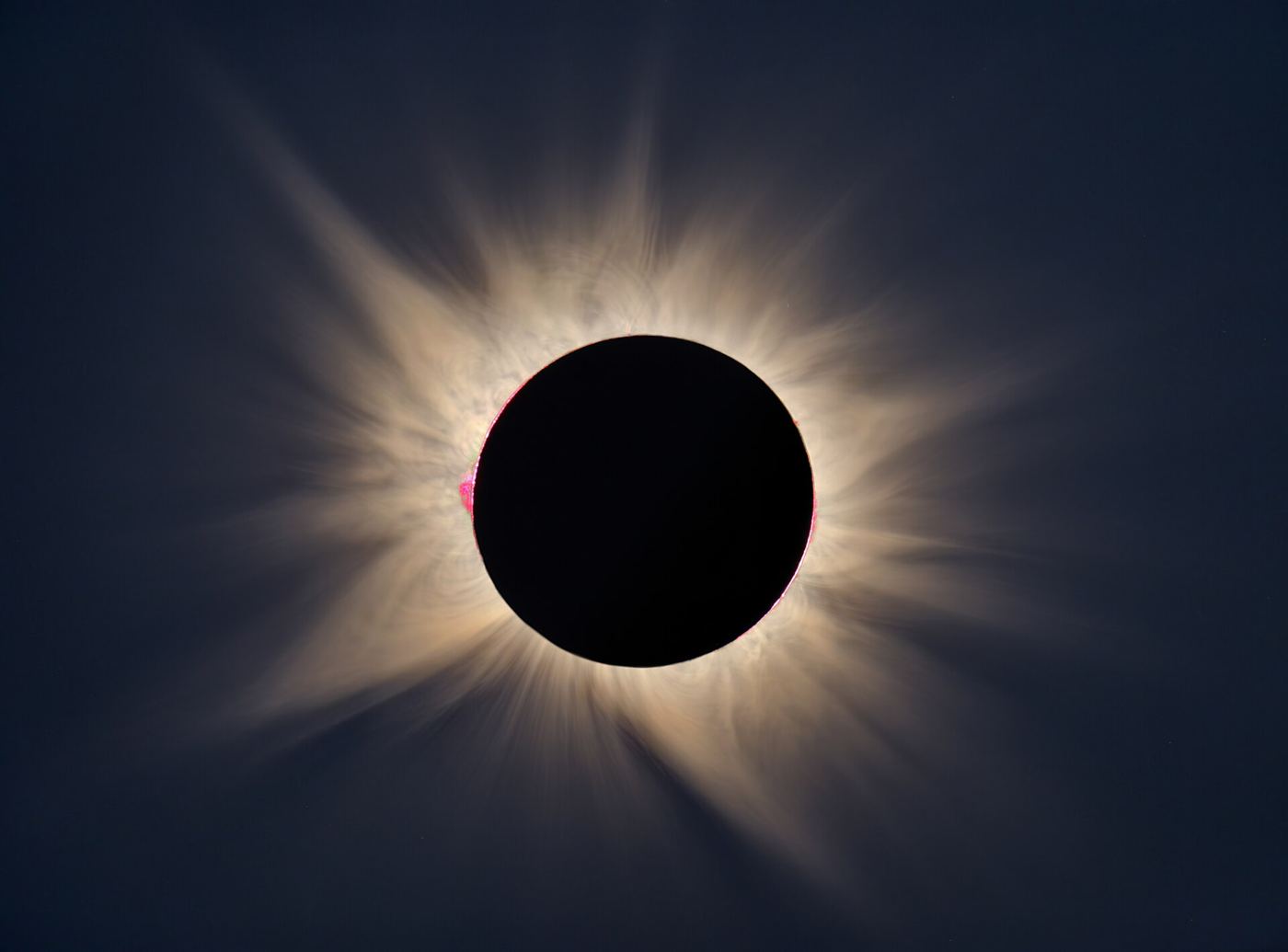
On 12 August 2026, day turned to night along a narrow path from the Arctic across Greenland and Iceland to northern Spain. It was the only total solar eclipse of the year, the first visible from Iceland since 1954, and the first over mainland Spain since 1905. The Moon’s shadow swept across the North Atlantic, reaching greatest eclipse at about 17:47 UTC, with totality lasting up to two minutes and eighteen seconds at its longest point off the west coast of Iceland. In Reykjavik, the partial eclipse began in the late afternoon and totality arrived at about 17:48 local time, while in northern Spain the Sun was already low in the west, about an hour before sunset, when darkness fell. Madrid and Barcelona, just outside the path, saw only a deep partial eclipse. Crowds gathered at viewing sites, on hillsides and on beaches, wearing eclipse glasses for the partial phases and looking up with the naked eye only during totality, when the Sun’s pale corona became visible around the black disc of the Moon.
What the Evidence Shows
A total eclipse is rare for any one place, which is why astronomers and tourists travel long distances to see it. The Moon is about four hundred times smaller than the Sun but also about four hundred times closer to Earth, so it can cover the Sun almost exactly, revealing the corona, the Sun’s outer atmosphere, which is normally hidden by glare. During totality, the sky darkens, the temperature drops, birds fall silent and bright stars appear in the middle of the day. Scientists use those few minutes to study the corona, test instruments and measure the Sun’s shape, while photographers chase the brief window of darkness. The next total solar eclipse comes on 2 August 2027, crossing southern Spain, North Africa and Egypt, and Spain will see another total eclipse in 2027 after waiting more than a century for the 2026 event. For those who stood in the shadow, the memory is of a strange, beautiful darkness in the middle of a summer afternoon. Reporting and analysis from sources such as Nature track the same developments, and specialists following total solar eclipse 2026 say the direction is now consistent across independent lines of evidence.
The Wider Context
The wider context is a research landscape in which replication and open data now decide reputations. Findings connected to total solar eclipse 2026 are being checked by independent groups with shared datasets, and the teams involved publish their methods in full so rivals can test every step. That discipline is slower than a headline cycle, but it is why results in this area increasingly survive first contact with scrutiny.
What Happens Next
What happens next in the story of total solar eclipse 2026 will be decided by follow-up work already under way: larger samples, longer observation and instruments that have not yet come online. The researchers involved are unusually united on one point, that the current results justify the next investment of time and money. Readers will not have to wait long for the first tests of that claim. You can follow related developments in our coverage of science.
None of this will be settled by a single announcement, study or product launch. The pattern to watch is accumulation: independent confirmations, honest reporting of failures and steady improvement in the underlying numbers. Readers who follow those signals, rather than the loudest claim of the week, will understand this subject better than most of the commentary surrounding it suggests is possible.
